There’s no prize for faking it or hustling for gold stars. You don’t need to be “fixed”—you need to be free. These lessons are for anyone tired of chasing perfect, anyone in recovery (or just in the weird middle of life), and anyone who wants more than fake positivity and feel-good advice. Read, reflect, and do these lessons alone if you want—but you’re never actually alone. If this stuff trips you up, reach out. Seriously. And yeah, I’m available for 1-on-1 work if you want hands-on help.
🎉 You finished the whole class. I’m proud of you. Progress is progress.
You’ve been lied to. Told if you just “tried harder,” did it “perfectly,” and “got your shit together,” life would finally be easy—or at least bearable. Newsflash: perfection is a moving target set by fear, shame, and old stories that keep us stuck in the mud.
Perfectionism isn’t your friend. It’s a prison guard dressed like a cheerleader. It tells you:
“If you can’t do it right, don’t do it at all.”
“If you mess up even once, you might as well quit.”
“Others are watching—you have to look good forever.”
These thoughts aren’t facts—they’re lies designed to make you freeze.
Clinically speaking, perfectionism is poison in recovery and growth. It creates:
If you’ve ever skipped a meeting because you missed one, or quit a diet because you ate one cookie, you’ve been dancing with this beast. The truth? Perfectionism kills progress way more than any slip you ever have.
I spent years chasing “perfect recovery.” I hid relapses because “real addicts don’t mess up.” I waited for the “right moment” to start fresh—and almost died waiting. It wasn’t until I owned my mess, my imperfect comeback, and my ugly wins that I got free.
You don’t have to wait to be good enough to start moving. You get to start messy. You get to stumble and keep going.
Your mission, should you choose to accept it:
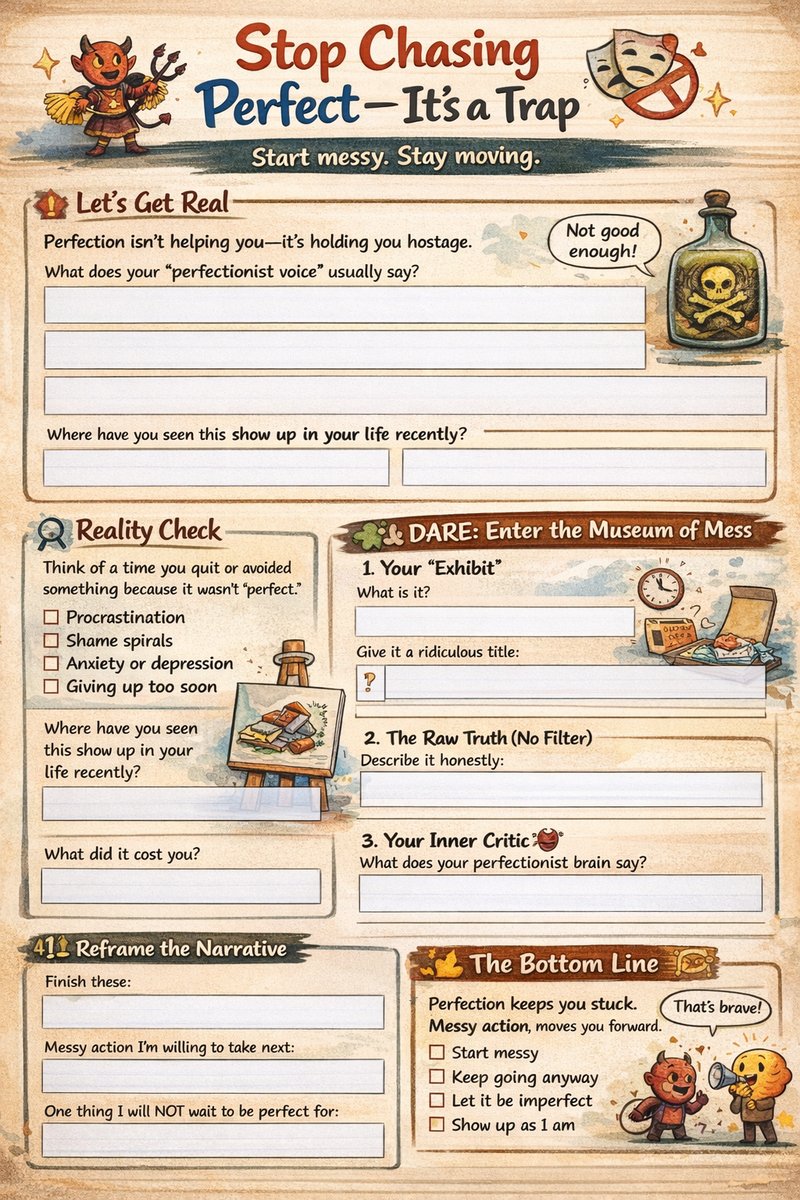
Find something in your life right now that you usually hide because it’s messy, imperfect, or embarrassing.
It can be anything: a cluttered desk, a forgotten bill, an unfinished project, a thought you wouldn’t admit out loud, a recent slip or relapse.
Take a photo or write a wildly honest description. No photos? No worries. Paint the picture with words.
Give it a ridiculous, over-the-top museum exhibit name. For example:
Write down what your perfectionist brain says when it sees this mess. Then write what you’d say to a friend who showed you theirs.
Exposure breaks shame’s power. When you make your mess visible, less scary, and even funny, you take back control. This is the foundation of real progress—seeing your real self without judgment.
“My ‘museum piece’ is my junk drawer, filled with receipts from 2023. I told myself, ‘You’re lazy and disorganized,’ but I’d tell a friend, ‘You’re just busy, that’s all.’”
“I wrote about a slip I had last month. My brain said, ‘I’m a failure forever.’ The friend voice said, ‘You’re human, and you tried again.’”
If this stirs up shame so heavy it feels crushing, please pause. You are not alone. Reaching out isn’t weakness—it’s strength.
I’m here for you:
Brené Brown’s Listening to Shame TED Talk (because shame is the core of perfectionism)
Perfectionism as a Clinical Issue (for the science nerds—you’re among friends!)
Perfection is a myth designed to keep you frozen. You don’t have to wait to be “ready.” Your progress begins when you step into the mess, own it, and defy the lie that you must be flawless to move forward.
👊 Reminder: If you get stuck or overwhelmed, reach out! Support is strength, not failure. I’m here for coaching and support anytime. DM me or book a free consultation.
🔥 Your Dare: Do your Museum of Mess and bring that messy masterpiece back to this journal or notes app. No judgment, only progress. 👊
Worksheet
If you’re waiting for a giant breakthrough moment—forget it. Real progress isn’t headline news. It’s the tiny, invisible wins nobody notices but your brain needs.
Most people give up the second they don’t see dramatic change. But change isn’t a sprint; it’s a crawl, a stumble, a wobble, repeated over and over. Especially if you’re in recovery or healing from trauma, depression, or burnout, the little things are everything.
Clinically, this is called “micro-success”:
On the flip side:
Ignoring micro-wins keeps you neurochemically stuck in shame and frustration cycles. You think you’re “not doing enough,” which kills motivation.
I used to dismiss brushing my teeth or getting out of bed as “not enough.” Turns out, those were huge moves for my brain stuck in depression and addiction.
I remember a client who celebrated not responding to a toxic text as a win—and that was the line she drew to keep her sobriety alive that week.
Your Mission:
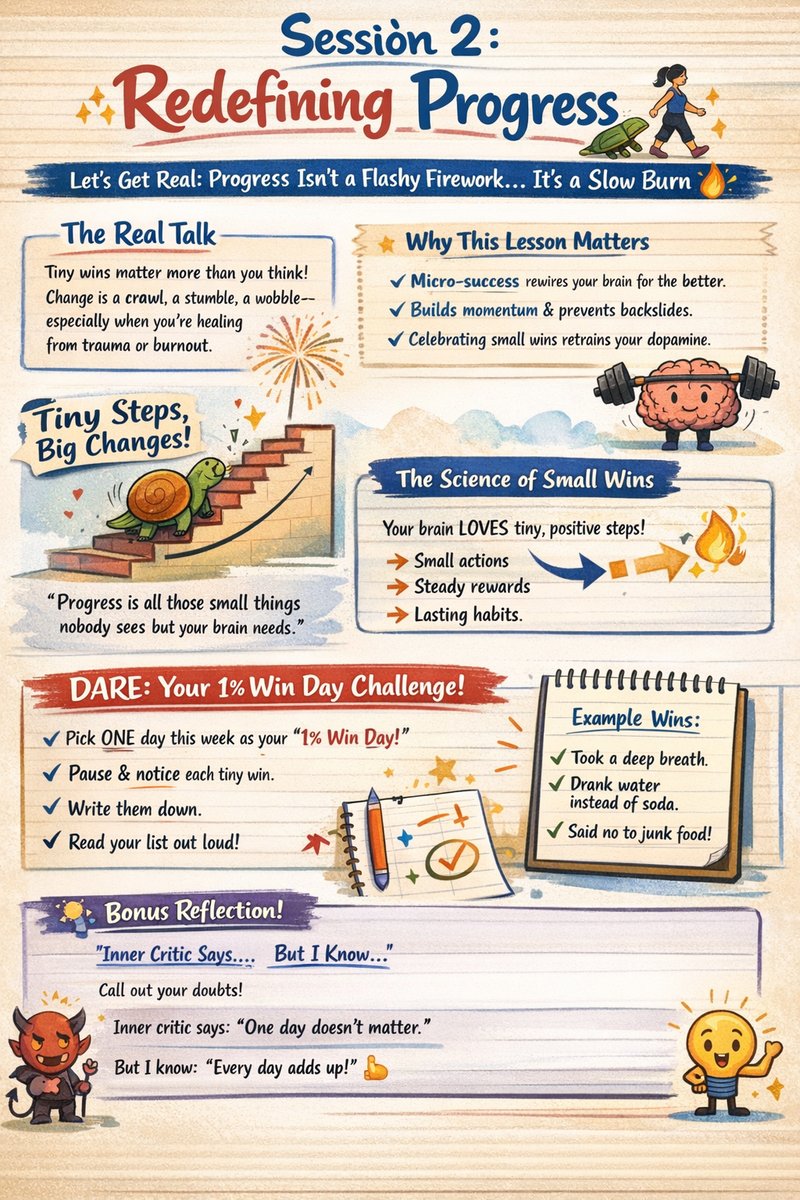
Pick ONE day in the next week and call it your “1% Win Day.”
Every time you do something even a tiny bit better than usual, stop and notice it.
It could be:
Your brain thrives on proof that change is happening—even if the proof is tiny. Recognizing small wins helps you build hope and stick to your path—especially when progress feels impossible.
Your brain probably wants to downplay these wins. (“Big deal, you’ve still got a long way to go.”) Call it out:
Write next to one win: “Inner critic says…” and then, “But I know…”
Example:
“Didn’t drink today. Inner critic says: ‘One day doesn’t change much.’ But I know: every day adds up, and I’m still here.”
If celebrating small wins feels impossible or makes you feel worse, it’s a sign to reach out.
I’m available for coaching calls anytime. You can book a free consultation to get started.
Or DM me directly. Support is a tool—not a crutch.
Forget the flashy milestones for now. Celebrate showing up. Celebrate the tiny things. Your progress is real, it is worth noticing, and it is happening—one imperfect step at a time.
🔥 Your Dare: Set your 1% Win Day, track those wins, and celebrate like a champion—even if it’s just YOU cheering. 👏👏👏
👊 Remember, you’re not alone on this journey. If it gets heavy, reach out anytime!
Worksheet
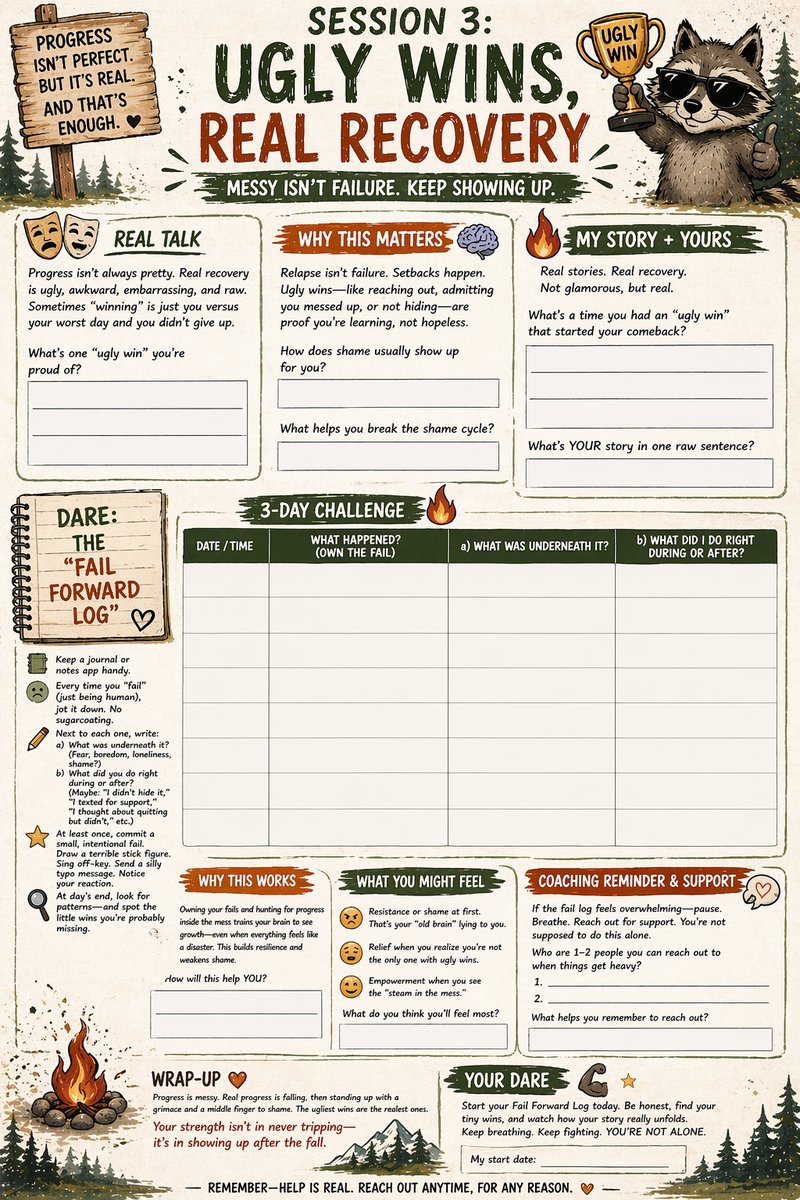
Forget the shiny highlight reels you see on social media or in polished recovery stories. Real progress is often ugly, messy, embarrassing, and raw as hell.
In fact, the moments you’re most tempted to hide—the slip-ups, the relapses, the “close enough” wins—those are often the most powerful steps forward.
Relapse is not failure; it’s part of recovery. Science shows that many people in recovery cycle through setbacks before sustained success.
Ugly wins—those moments when you choose to reach out even after you mess up, or when you apologize even if you want to hide—are crucial markers of progress. They reconnect you to learning and growth.
Shame around ugly wins fuels secrecy and isolation, driving more relapses and hopelessness.
I had a client, K., who relapsed after 6 months clean and felt like she had “wasted everything.” She stayed in bed most of a week, convinced she was doomed. When she finally texted her sponsor, even though she wanted to run away, that was progress. The ugly, scary moment that began her comeback.
I’ve been there too. People think my recovery is “perfect” because I’m a counselor, but I still wrestle with ugly wins every day.
Your Task for the Next 3 Days:
Keep a journal or notes app open. Every time you “fail” or slip from a goal (lighting up a cigarette, skipping therapy, overeating, yelling, relapsing, ghosting a friend), write it down.
Be brutally honest. No sugar coating.
Next to each fail, write:
On ONE of these days, commit a small intentional fail. Something silly or goofy, like drawing a terrible stick figure, singing off-key, or sending a goofy typo message. Notice your reaction.
Reflect at day’s end: What patterns do you see? What little wins did you forget to give yourself credit for?
By acknowledging fail moments honestly AND finding an ember of progress inside them, you train your brain to recognize growth even when things look bad. This builds resilience and breaks shame loops.
Progress is messy. It’s falling down, then standing back up with a grimace and a middle finger to shame. The ugliest wins are the real ones.
Your strength is in showing up after the trip, not in never tripping.
🔥 Your Dare: Start your Fail Forward Log now. Be honest, find your tiny wins within the fails, and note how your story really unfolds. Keep breathing, keep fighting. You’re not alone. 🦾🔥
👊 And remember—help is real. Reach out anytime, for any reason.
Worksheet
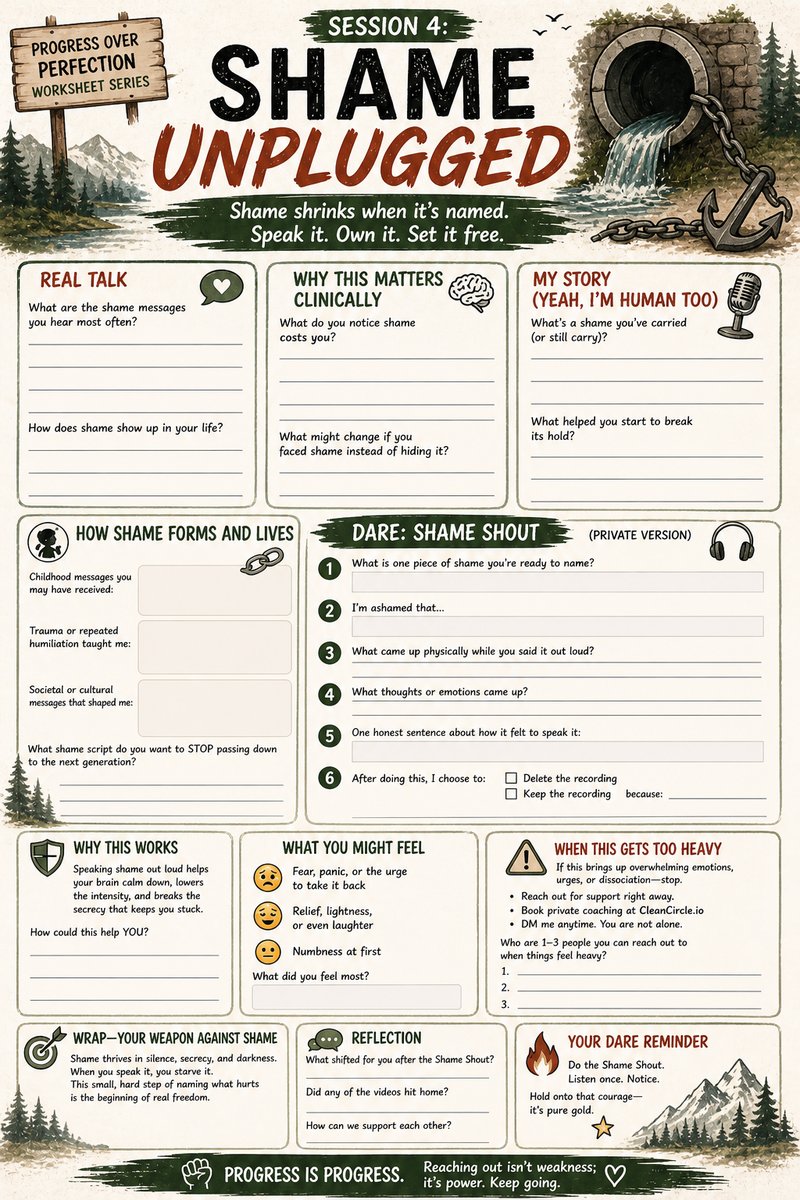
Shame is brutal. It’s the low rumble beneath the surface that whispers, “You’re not good enough,” “If they really knew, they’d leave,” and “You are the problem.”
In recovery and real life, shame is a killer. Clinically, it’s linked to relapse, mental health crises, self-sabotage, and isolation. Your shame tells you to stay silent, alone, and fixed in place.
But here’s the thing: shame shrinks when named.
I still fight crippling shame around things I “shouldn’t” be ashamed of (relapse urges, parenting struggles, messed-up relationships). It’s like a shadow that follows no matter how educated or aware I am. What saved me? Saying the shame out loud (to myself, in therapy, with trusted people)—the voice got smaller each time after that.
Your Task:
Record yourself saying it out loud. Don’t edit or sugarcoat. Example opener:
“I’m ashamed that I _.”
Listen to the recording once. Notice your feelings.
Write down one honest sentence about how it felt to actually say it out loud.
Delete or keep the recording—it’s your call. The win is speaking it.
Owning your shame publicly—even just to yourself—disarms its power over you. It moves shame from a monster you hide from into a story you’ve told.
Brené Brown’s Listening to Shame (TED Talk)—one of my all-time favorites.
SAMHSA National Helpline for crisis or support.
Shame wants silence, secrecy, and darkness to survive. When you speak it, it loses its grip. The small, hard step of naming shame is the beginning of freedom. You’re doing the hardest part already.
🔥 Your Dare: Record your Shame Shout, listen once, and notice what happens. Hold onto your courage—it’s gold. ✨
👊 Remember, reaching out for help is not weakness, it’s power. I’m here for coaching and support:
Worksheet
You might think that with enough motivation, willpower, or a “perfect plan,” you can change everything overnight. Spoiler alert: that’s a lie. Motivation waxes and wanes like the tide, but systems and tiny habits tip the scales for lasting change.
Trying to rely on motivation alone is like trying to swim upstream during a thunderstorm. It’s exhausting and unsustainable.
Clinical perspective:
Studies on habit formation show it takes consistent, small actions to rewrite neural pathways. Behavioral activation (a gold-standard therapy technique) is all about starting with tiny behaviors to spark bigger change. It beats motivation every day.
From lived experience:
I’ve started big—and crashed hard, over and over. But the habits I built from almost nothing (putting on shoes, writing one sentence, taking one breath) have saved me when motivation tanked.
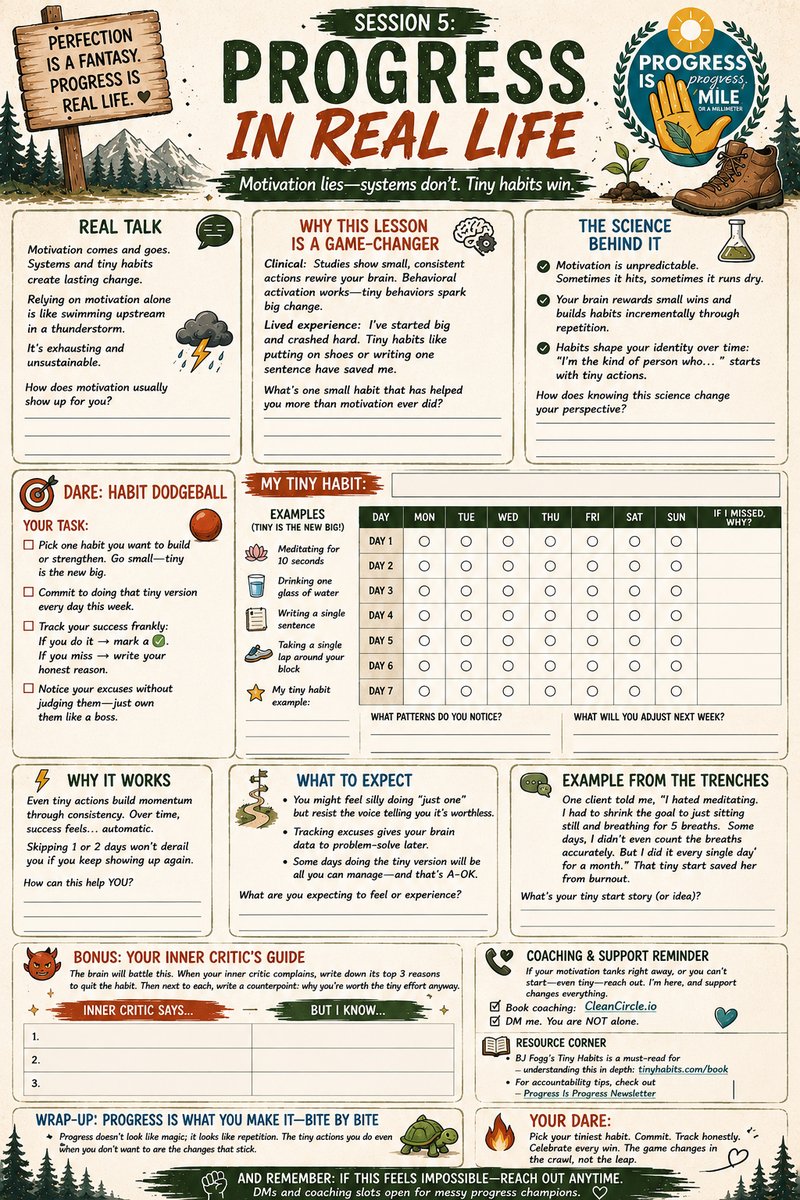
Your Task:
Pick one habit you want to build or strengthen. Go small—tiny is the new big.
Examples:
Even tiny actions build momentum through consistency. Over time, success feels… automatic. Skipping 1 or 2 days won’t derail you if you keep showing up again.
One client told me, “I hated meditating. I had to shrink the goal to just sitting still and breathing for 5 breaths. Some days, I didn’t even count the breaths accurately. But I did it every single day for a month.” That tiny start saved her from burnout.
The brain will battle this. When your inner critic complains, write down its top 3 reasons to quit the habit. Then next to each, write a counterpoint: why you’re worth the tiny effort anyway.
BJ Fogg’s Tiny Habits is a must-read for understanding this in depth: tinyhabits.com/book
Progress doesn’t look like magic; it looks like repetition. The tiny actions you do even when you don’t want to are the changes that stick.
🔥 Your Dare: Pick your tiniest habit. Commit. Track honestly. Celebrate every win. The game changes in the crawl, not the leap.
👊 And remember: If this feels impossible—reach out anytime.
DMs and coaching slots open for messy progress champions.
Worksheet
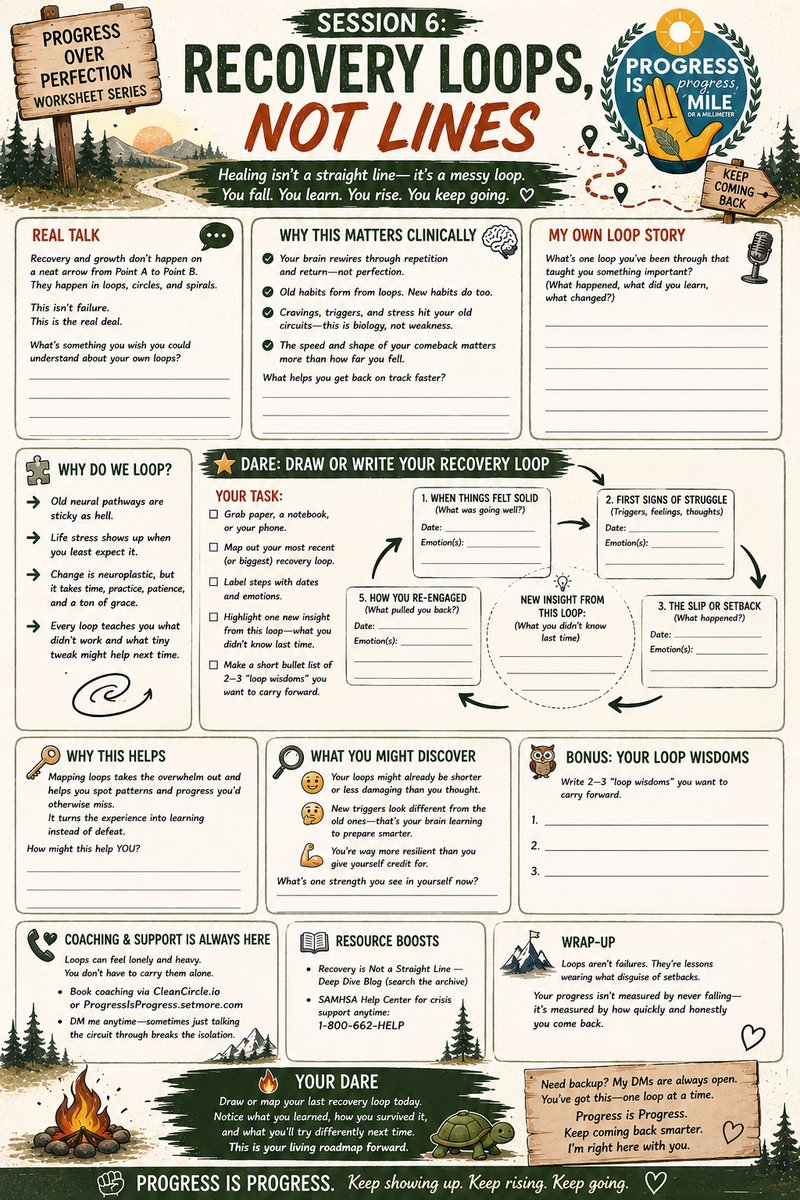
If you’re stuck staring at your “fail” moments and feeling like you’re going backward, stop. Recovery and growth don’t happen on a straight arrow from Point A to Point B.
They happen in loops, circles, spirals—you fall, you get up, you learn a bit, you fall again, you change direction. This is not failure. It’s the real deal.
Your brain forms habits from repetition, not perfection — it rewires by looping through old behaviors and new attempts.
Cravings, triggers, stress hit your “old circuit” hard—that’s biology, not weakness.
The speed and shape of your comeback are better markers of progress than “how far you fell.” Clinical relapse prevention focuses on rapid re-engagement, not zero slip-ups.
I still catch the urge to quit recovery sometimes when life piles on. The difference now? I recognize it as part of my loop. I’ve learned to “fall less far, get back faster,” and most importantly, not define myself by the fall.
Your Task:
Take a piece of paper, notebook, or phone notes app.
Plot your most recent (or biggest) recovery loop:
Highlight one new insight from this loop about what you didn’t know last time (a trigger, a coping gap, or a support you didn’t use).
Make a bullet list of 2-3 “loop wisdoms” you want to carry forward.
Seeing loops mapped out makes them less overwhelming, and helps you spot patterns and progress you might otherwise miss. It’s learning, not failing.
👊 Need backup? Reach out anytime:
DMs always open.
Worksheet
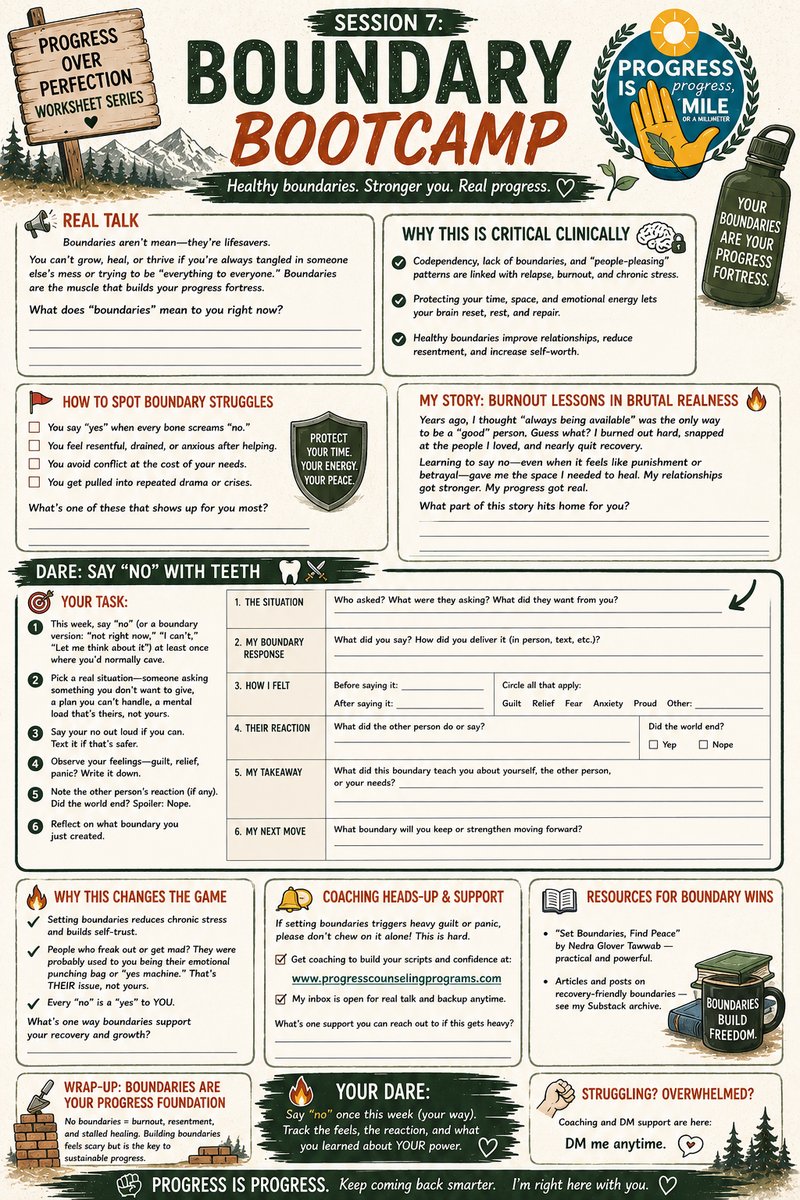
Boundaries get a bad rap. People think “setting boundaries” means yelling NO all the time, being cold, or burning bridges. Nope. Boundaries are your emotional life jackets. They save you from drowning in other people’s chaos, guilt, and drama.
You can’t grow, heal, or thrive if you’re always tangled in someone else’s mess or trying to be “everything to everyone.” Boundaries are the muscle that builds your progress fortress.
Years ago, I thought “always being available” was the only way to be a “good” person. Guess what? I burned out hard, snapped at the people I loved, and nearly quit recovery.
Learning to say no—even when it feels like punishment or betrayal—gave me the space I needed to heal. My relationships got stronger. My progress got real.
Your Task:
This week, say “no” (or a boundary version: “not right now,” “I can’t,” “Let me think about it”) at least once where you’d normally cave.
Pick a real situation—someone asking something you don’t want to give, a plan you can’t handle, a mental load that’s theirs, not yours.
Say your no out loud if you can. Text it if that’s safer.
Observe your feelings—guilt, relief, panic? Write it down.
Note the other person’s reaction (if any). Did the world end? Spoiler: Nope.
Reflect on what boundary you just created.
“Set Boundaries, Find Peace” by Nedra Glover Tawwab — practical and powerful.
Articles and posts on recovery-friendly boundaries — see my Substack archive.
No boundaries = burnout, resentment, and stalled healing. Building boundaries feels scary but is the key to sustainable progress.
🔥 Your Dare: Say “no” once this week (your way). Track the feels, the reaction, and what you learned about YOUR power.
👊 Struggling? Overwhelmed? Coaching and DM support are here:
DM me anytime.
Worksheet
Burnout doesn’t announce itself. It’s not just “feeling tired.” It’s that heavy fog that turns your fight into giving up. It’s the creeping numbness, the itch to check out, the loss of what used to bring you life. If you ignore burnout, it will crash everything you’re building.
I’ve burned so many candles at both ends that my body staged a full rebellion—heavy anxiety, immune crashes, and near total shutdown. Burnout felt like “I’m broken forever,” until I learned to read the signs and treat rest as a non-negotiable part of progress.
Your Task:
Write a brutal and honest letter to yourself titled:
“How I Know I’m Burning Out (And What To Do About It).”
Include:
Bonus:
Set a reminder to read it anytime you feel your energy dip below “meh.”
Having clear burnout signals and a plan means you catch yourself before the crash. Resting isn’t a luxury—it’s your rocket fuel for progress.
Burnout can feel isolating. You don’t have to ride it solo.
Book a free consultation to talk about coaching for systems that build sustainable progress.
DM me—sometimes just unloading helps more than “power through.”
“Burnout: The Secret to Unlocking the Stress Cycle” by Emily Nagoski, PhD
Ignoring burnout is like driving with the check-engine light blinking nonstop. Resting isn’t quitting. It’s the fuel that keeps your progress moving forward—not faster, but further.
🔥 Your Dare: Write your burnout letter and keep it close. Use it early—you deserve to protect your progress with rest.
👊 Burnout dragging you down? You’re never alone—reach out anytime:
DMs, coaching, support—all here.
If you’re in recovery or on any real growth journey, people matter—a ton. But sometimes, the very people you love most can stall or wreck your progress without even meaning to.
Codependency is the sneaky pattern where your progress feels tied to someone else’s mood, approval, or drama. It’s not weakness, it’s learned survival—but it can keep you stuck in loops and pain.
I saw a client lose 90 days sober because her partner relapsed, and she fell right back in—not for her choice, but because her “people-pleaser wiring” wouldn’t let her step back.
We mapped her “people triggers” and practiced saying no fiercely. Progress didn’t happen overnight, but it happened.
Your Task—One Day Only:
For one full day, notice every time you adjust your mood, plans, or energy BECAUSE of someone else’s vibe—good or bad.
Examples:
Awareness is the first (and sometimes hardest) step out of codependency. Catching when you’re reacting instead of choosing breaks old cycles and begins reclaiming your power.
“Codependent No More” by Melody Beattie—classic and powerful
You cannot change others, but you can choose how you respond. Reclaim your progress by reclaiming your choices.
🔥 Your Dare: Track your people-trigger reactions for one day. Notice what freedom might feel like if you acted on your own terms.
👊 Struggling? Overwhelmed? I’m here—reach out anytime:
DMs open always.
Who you surround yourself with matters. Especially in recovery and real growth, your circle can either light your path or block your way.
Some people are rock-solid supporters who cheer your smallest wins. Others drain your energy, push you toward old patterns, or just don’t get the real you anymore.
Pretending everyone is “on your side” is a trap. Cleaning house of your social circle? It’s one of the most powerful things you can do.
Journal:
This is about protecting your energy and mental health. Boundary-setting extends into your social circle—this audit uncovers who supports your messy, real progress.
“The Power of Community and Recovery” — real stories and science.
Codependency & Relationship Help resources.
You can’t pour from an empty or toxic cup. Choosing who’s in your circle is choosing your peace, growth, and future.
🔥 Your Dare: Do your Circle Audit and experiment with muting one draining contact for three days. See what changes.
👊 Need a sounding board? I’m here—reach out any time:
DMs open every day.
Thinking you have to tell the “perfect recovery story” to be worthy? Nope. Real progress stories are raw, tangled, sometimes embarrassing—and powerful because of that.
Telling your story as you live it—with the cracks, screw-ups, ugly wins, and all—builds real resilience and connection. It’s the radical opposite of perfectionism.
Trust me, I’ve told plenty of messed-up progress stories. Like the time I went 3 months without calling a sponsor, then showed up anyway. Or when I cried through an entire group session feeling like a failure. Those stories weren’t pretty, but they were real.
Your Task:
Progress is about being real. When you own your story, shame loses power. You send a message— to yourself and others—that imperfect is enough.
You don’t have to be perfect to inspire. The mess, the grit, the honesty—that’s where real strength shines.
🔥 Your Dare: Craft or record your real progress story and hold it close. Own your wild, beautiful, messy journey.
👊 Feeling exposed? Overwhelmed? Reach out for one-on-one backup anytime:
DMs always open.
This isn’t the end of your journey—it’s a new chapter. Real progress doesn’t have a finish line, because life keeps changing and so do you.
What matters now is having a plan for when things get messy again. Because they will.
I keep a “time capsule” note for my future self—reminders, pep talks, and strategies to lean on when the shadows creep in. It’s my secret weapon against panic and shame.
Your Task:
Write or record a message to yourself dated 3 months from now.
Include:
Your future self is your biggest ally. When you feel lost or stuck, that capsule is a lifeline pulling you toward what you already know works—your messy, real progress.
FutureMe.org (free, simple way to send your time capsule)
Crisis & support helplines: SAMHSA National Helpline (1-800-662-HELP)
👊 Remember: You are not alone. Support and coaching are here when you need them.
DMs always open for real talk.
These classes are educational and not a substitute for professional care. If you are in crisis, call or text 988.